
Our Work

Canada's online information ecosystem has fundamentally changed and so has Canadians’ definition of news
June 25, 2026 - A new report from the Media Ecosystem Observatory (MEO) draws on nearly 9 million social media posts and a national survey of 1,518 Canadians to document how journalism is losing ground online, and what is filling the void.

CMTD releases new research on social media safety, age verification, and AI governance amid major shift in Canada’s digital policy landscape
June 25, 2026 - As Canada advances a series of major digital policy initiatives, the Centre for Media, Technology and Democracy and the Media Ecosystem Observatory are releasing a new body of research examining some of the most consequential questions facing policymakers.

Facebook's News Slop Economy: The Foreign Content Farm Flooding Your Feed, And Making Money From It
June 8, 2026 - A new incident response report exposes a coordinated network of 340 Facebook pages, largely operated from Vietnam, flooding feeds across Canada, the US, the UK, and Europe with AI-fabricated news, and inadvertently funded by Canadian public and private advertisers.

Four things to watch out for in the Digital Safety Act
June 8, 2026 - A redrafted Online Harms Act is expected this week. Taylor Owen identifies four things to watch out for in the new bill, drawing from his submissions to the AI Task Force and the Expert Panel on Online Safety, and on the federal and provincial policy work that followed the Tumbler Ridge shooting. For each, Owen address specific details about the design choice, the likely objection, and the risk to passage if it is handled badly.
Gen(Z)AI Presents Policy Recommendations for AI and Online Harms Governance in Canada
April 30, 2026 - When we set out to design Gen(Z)AI: Canada’s Youth Assembly on Artificial Intelligence, we were animated by an urgent conviction: that young people, among the most exposed to and affected by AI systems, should not merely be subjects of this technology, but architects of its governance. What followed – across seven months, four cities, one hundred in-person participants, and thousands of virtually engaged young Canadians – exceeded our initial ambitions.

Left To Their Own Devices, nominated for Peabody Award
April 7, 2026 - From the Toronto Star
Left To Their Own Devices is a finalist for a prestigious Peabody Award, one of the highest international honours in journalism.
Hosted by Centre Youth Fellow, Ava Smithing, Left To Their Own Devices is a 10-part investigative podcast that explores the profound impact of social media and technology on youth. The Star partnered with Paradigms and the Centre for Media, Technology and Democracy at McGill University on the series which investigates how social media algorithms fuel obsessive use and addiction, push children toward self-harm, dieting content and violent pornography at younger ages.

AI News Audit: AI, Canadian Journalism, and Paths for Policy Action
March 16, 2026 - AI companies built their products using Canadian journalism without permission and without compensation, and are now delivering that journalism to consumers as their own product. Existing copyright and media policy frameworks were not designed to address this.
In February and March 2026, we conducted the first large-scale empirical audit of how AI models use and distribute Canadian journalism.

Scoping AI Chatbots into a revised Online Harms Act: The Case for Immediate Action
February 24, 2026 - The Centre’s Founding Director, Taylor Owen, and Helen Hayes, Associate Director of Policy, are calling for immediate action to scope AI chatbots into a revised Online Harms Act.
New study finds conspiracy theory beliefs amplified by a small number of highly active accounts
The Centre’s Media Ecosystem Observatory released a new national brief that finds limited belief in conspiracy theories, but outsized visibility driven by a small number of highly active online accounts.
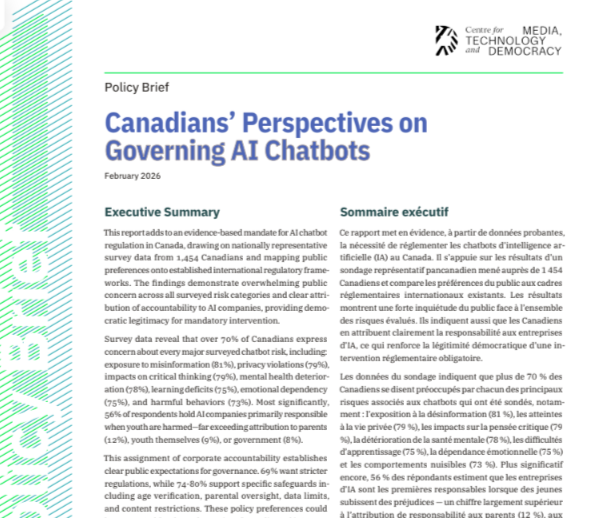
Canadians’ Perspectives on Governing AI Chatbots A Policy Brief
This report adds to an evidence-based mandate for AI chatbot regulation in Canada, drawing on nationally representative survey data from 1,454 Canadians and mapping public preferences onto established international regulatory frameworks. The findings demonstrate overwhelming public concern across all surveyed risk categories and clear attribution of accountability to AI companies, providing democratic legitimacy for mandatory intervention.
Final Report to the AI Strategy Task Force
January 22, 2026 - In the Fall of 2025, the Minister of AI and Digital Inclusion Evan Solomon announced the creation of Canada’s National AI Task Force. The Centre’s Founding Director, Taylor Owen, was asked to be part of it. The members of the task force had one month to develop recommendations on different AI-related themes. Taylor’s focus was governance, safety and trust. His full memo is included below.

Welcoming Anna Jahn as Executive Director of the Newly Merged Centre for Media, Technology and Democracy
We are thrilled to announce that Anna Jahn will be joining McGill as Executive Director of the newly merged Centre for Media, Technology and Democracy and Media Ecosystem Observatory. Anna will also serve as Associate Professor of Research at McGill University’s Max Bell School of Public Policy.


New Report Calls for Bold, Systemic Reform of the CBC/Radio-Canada
This report presents the findings of a two-year study that draws on best practices in public service media from within Canada and in 17 other countries around the world. It is informed by consultation with a broad range of media and public media experts, as well as insights from our national survey, “Do We Need the CBC?” We sought to understand the current role of public media in the larger Canadian media landscape, to assess its relevance, and to propose appropriate recommendations to bring the CBC/Radio-Canada — and the resources allocated to it — in line with needs and expectations of Canadians today.

Youth deserve a safer internet. Will the new cabinet deliver?
Maddie Case, Zach Severyn, Ava Smithing & Maddie Freeman

How the next government can protect Canada’s information ecosystem
Taylor Owen & Helen A. Hayes


