
Publications
All Publications
Showing 150 of 150 resultsA Striking Lack of Evidence: Did Ukraine’s Bombing of Russian Data Centres Wipe Out Kremlin Bots?
After Ukrainian drone strikes on Yandex data centres from October 8 to 11, Cloudflare recorded a sharp drop in automated traffic from the affected servers. Online, users read this as a collapse in “Russian bots,” and claimed that Alberta separatism and right-wing movements in Germany, the UK and the U.S. had lost their online amplification. The drop reflected Yandex’s search-engine crawlers going offline, not social media bots. Drawing on posts from 113 leading voices in the Alberta referendum conversation on X, we find no dip in the engagement they received after the strikes. We also trace how the claim spread in the referendum conversation: posts endorsing it drew 73% of views, while posts disputing it drew only 14%.
October 2026Read more

October 2026Read more
Alberta’s Referendum, Online: Election Fraud Claims Ahead of the October 19 Vote
With less than two weeks to go before Alberta’s October 19 referendum, online posts raising concerns about special (mail-in) ballots have risen sharply, as Elections Alberta approved more than 652,000 of them — about 11 times more than in the 2023 general election. At the same time, confidence in Elections Alberta has fallen 18 percentage points since 2023, across the political spectrum, after a contentious 18-month process. Using the Calgary-Shaw by-election as a case study — where a recoloured copy of Wisconsin’s 2020 presidential vote count was passed off as Alberta data and drew about 260,000 views — this update shows how fraud claims are likely to circulate on referendum night, and why we expect them to be pulled into the American online ecosystem. 63% of Albertans expect U.S. political figures to try to influence the outcome, and 78% consider it inappropriate.
October 2026Read more

October 2026Read more
Weekly Update 5: Narratives and Perceptions of Electoral Integrity
The fifth in a weekly series tracking the information ecosystem during Quebec's 2026 election campaign. Following a news report on possible American interference and the start of advance voting, this edition focuses on electoral integrity: how much it has been discussed online since the start of the campaign, which narratives drove four distinct waves of discussion, whether posts assert, report, or refute them, and how little attention the election has drawn from American influencers, Russian and Chinese state media, and WeChat. Survey data show that most Quebecers trust Élections Québec, that concern about foreign interference did not rise after the report, and how well voters know the electoral process. The On Our Radar section examines whether it is legal to post a photo of your ballot.
October 2026Read more
October 2026Read more
Weekly Update 4: An Election Without News Media on Facebook
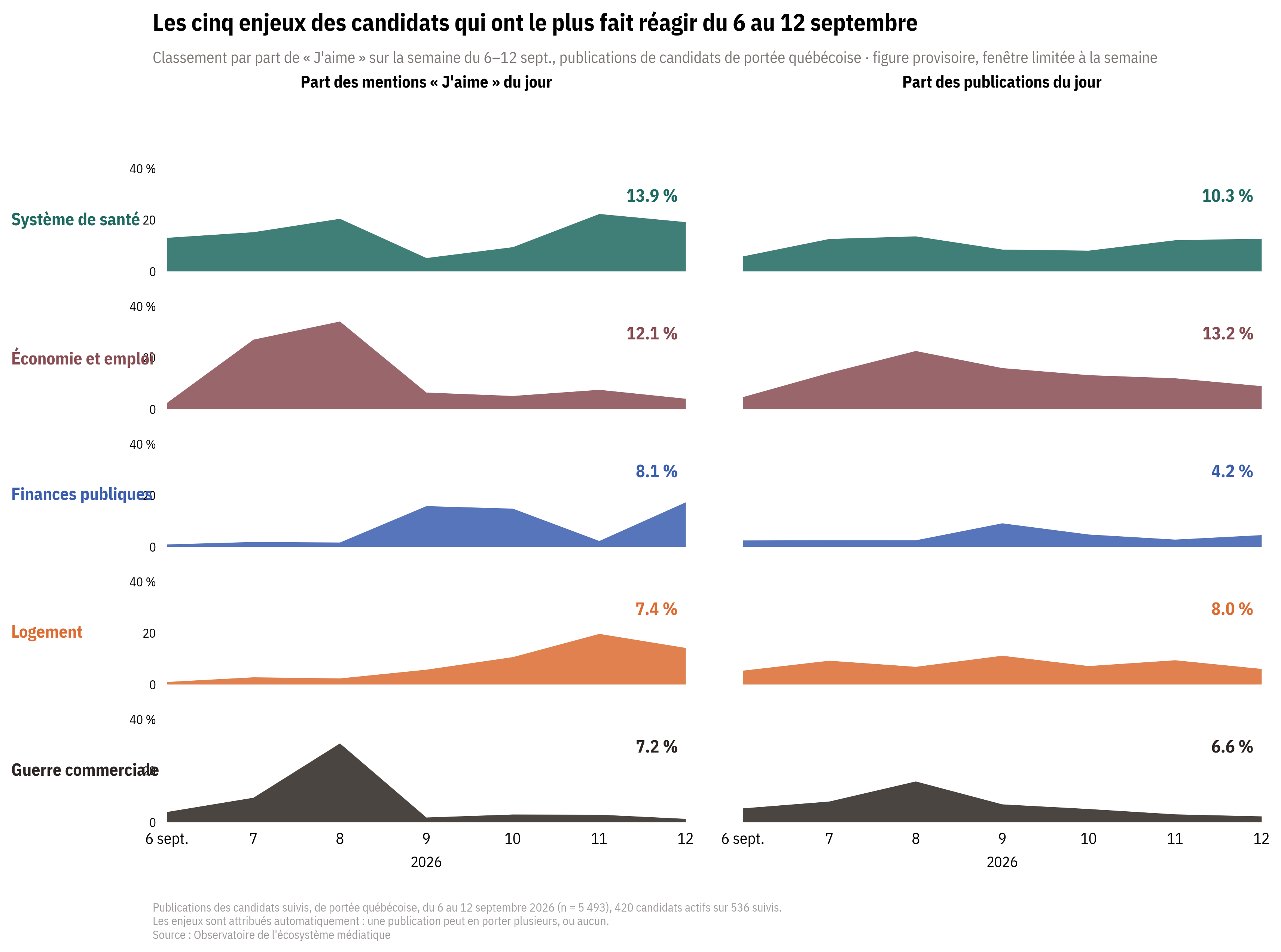
The fourth in a weekly series tracking the information ecosystem during Quebec's 2026 election campaign. With Facebook the platform Quebecers use most for political news, yet one where news outlets can no longer publish, this edition focuses on the campaign's information environment there: political ad spending and targeting, how narratives spread between candidates and influencers, and the discussion happening in dozens of partisan Facebook groups. The On Our Radar section tracks the growing reach of the AI-built voting-advice site lequebecvote.ca, rising polarization over immigration, concerns about the integrity of the electoral process, and Amnesty International's accusation that the Parti Québécois harassed a physician critical of the party.
September 2026Read more
September 2026Read more
Advancing Transparency of Artificial Intelligence Systems
CMTD's submission to Innovation, Science and Economic Development Canada's public consultation on AI transparency, drawing on CMTD research to address AI-generated content, AI interaction, information about AI systems, and AI incidents.
September 2026Read more
September 2026Read more
Weekly Update 3: Quebec's First Election in the Age of AI
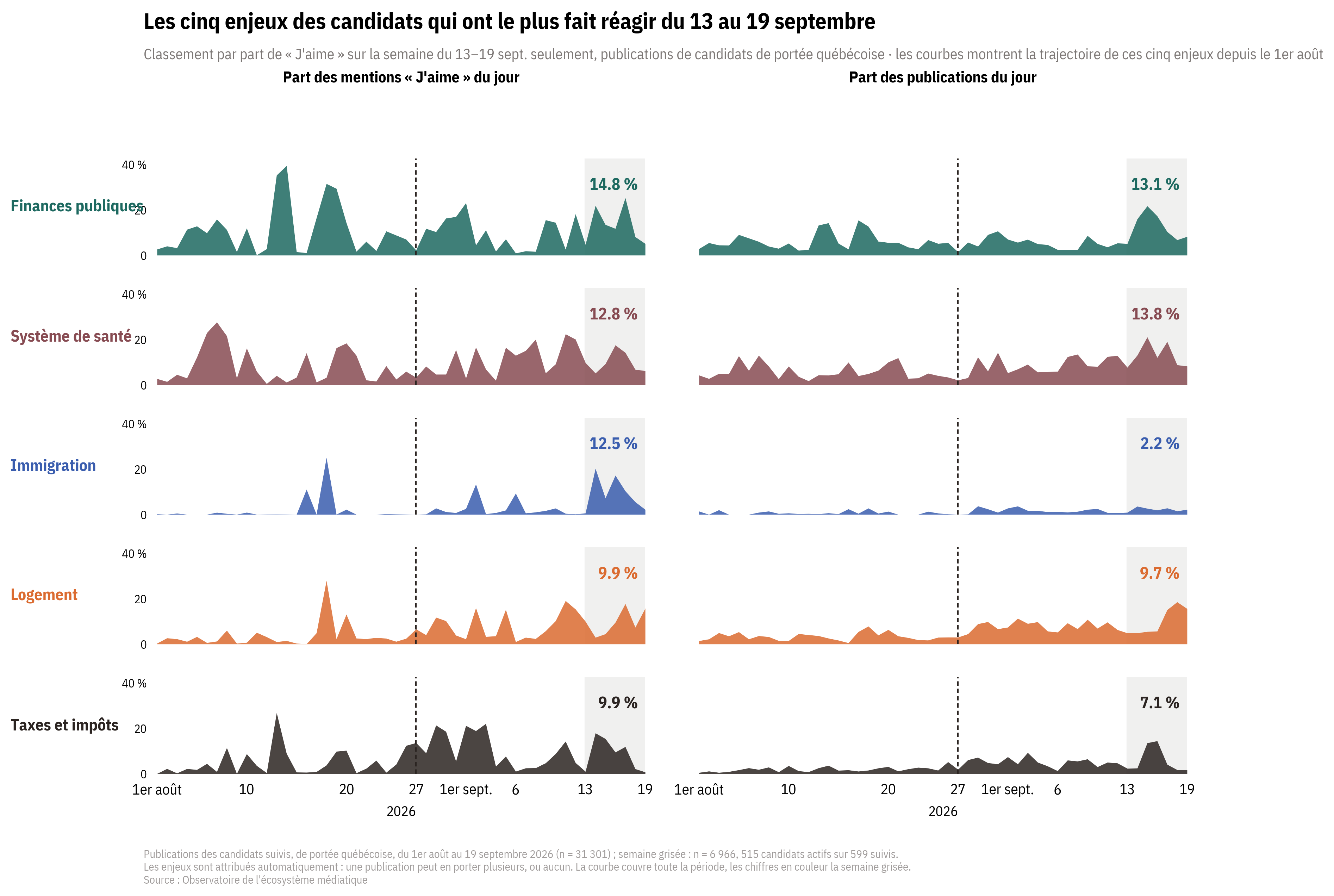
The third in a weekly series tracking the information ecosystem during Quebec's 2026 election campaign. This edition presents the results of an audit of the voting recommendations offered by ChatGPT and Google's AI Mode, showing how an anonymous AI-built website became a dominant source and how major outlets blocking AI crawlers is shaping the information voters are exposed to. The On Our Radar section covers vandalism of campaign materials, debates over the Coalition Avenir Québec's name, and discourse aimed at delegitimizing the electoral process.
September 2026Read more
September 2026Read more
Weekly Update 2: Three Agendas, One Election
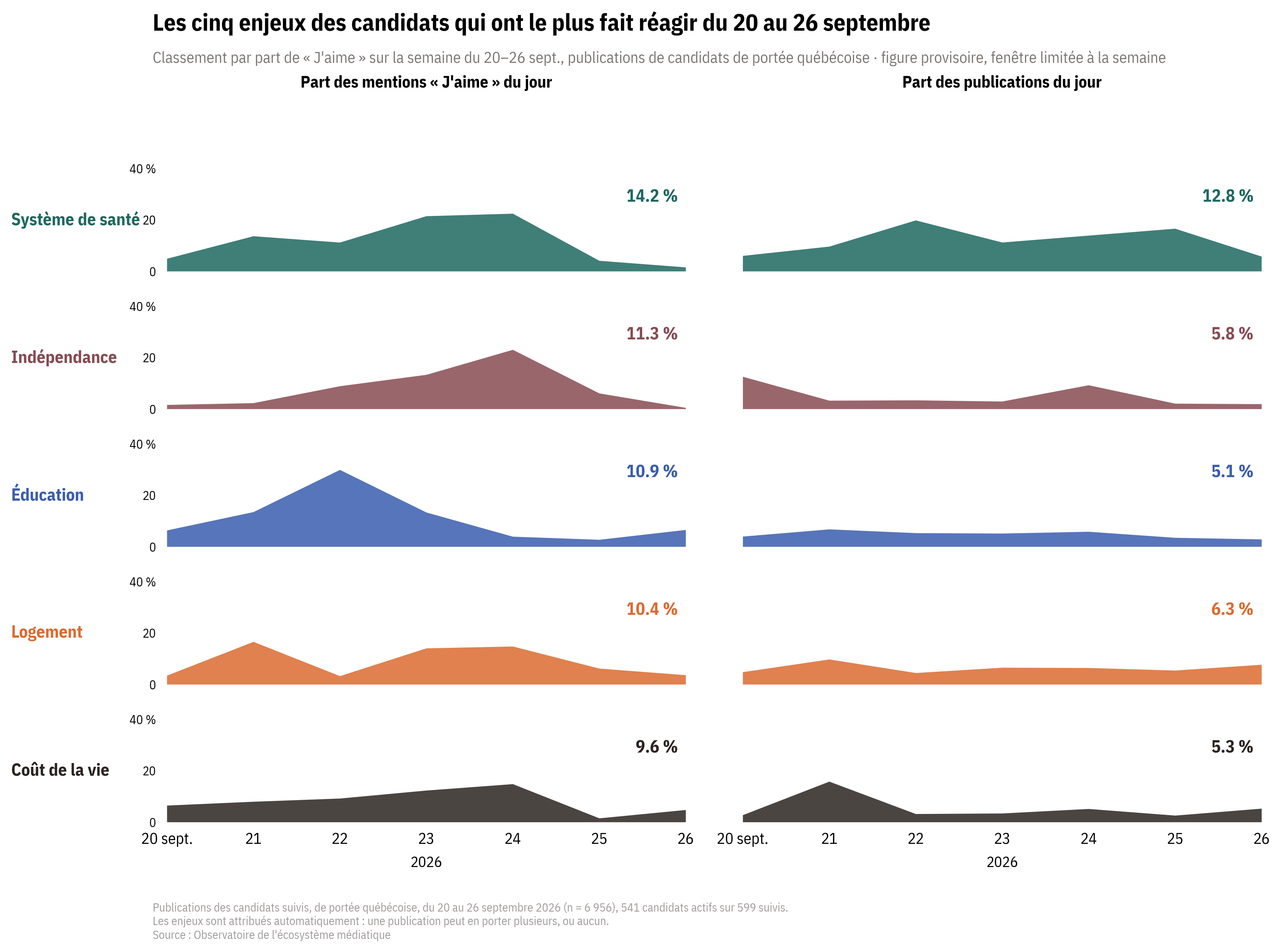
The second in a weekly series tracking the information ecosystem during Quebec's 2026 election campaign. This update looks at how candidates', voters', and online discussion's priorities have shifted from the trade war toward domestic economic issues, and compares the issues parties emphasize, the ones voters say matter most, and the ones dominating online conversation, finding three related but distinct agendas. The On Our Radar section covers allegations of federal government and La France insoumise interference in the campaign, along with discourse about the anglophone vote and hostility toward older voters.
September 2026Read more

September 2026Read more
Alberta’s Referendum, Online: Influencers, AI Content, Foreign Interest, and the Attention Economy Ahead of the October 19 Vote
Alberta is heading into a referendum on October 19, 2026, in a rapidly changing information environment. Year-over-year, online influencers have been accumulating relevance and engagement at the expense of news media and elected officials, and we now have a case study of what a democratic vote looks like squarely in the influencer era.
The online conversation about Alberta's referendum is driven by a passionate community of 114 accounts, unencumbered by traditional forms of political accountability, that have captured roughly half of all engagement generated since January 1, 2025, across five platforms. Among these highly influential voices, pro-independence accounts outperform anti-independence ones by a ratio of roughly 8:1. Posts about Alberta separating from Canada, irrespective of position, receive more than double the engagement of comparable other-topic posts — an online Alberta Advantage.
A second major transformation has recently occurred as voters turn towards AI search and chatbots to understand the political world around them. However, these tools are still maturing and provide changing responses to common and important political queries in the context of the referendum. We find that Google AI Overview and ChatGPT give inconsistent, sometimes directly contradictory answers to the same questions. At the same time, AI-generated imagery is quickly emerging as a campaign tool in the information environment, and we find that the share of AI images among pro-independence posts on X has grown 3.5-fold since January 2025.
These new sources of information and campaign techniques are enormously consequential during this democratic moment. Most importantly, there is a striking difference between the online conversation and the general public of Alberta. While polling shows roughly two-thirds of Albertans would vote to remain in Canada, the online conversations runs the inverse with far more posts and online engagement from the highly energetic independence movement. A political movement without elected leadership, but with a dominant online presence that harnesses rapidly maturing AI technologies, is driving the public conversation on a referendum related to whether Alberta should remain a province in Canada. All of this is unfolding while confidence that Elections Alberta will run the vote fairly sits at just 59%. Our democratic institutions and understanding of the public square must keep up.
September 2026Read more

September 2026Read more
Weekly Update 1: The Trade War Enters the Quebec Election Campaign
The first in a weekly series tracking the information ecosystem during Quebec's 2026 election campaign. This update looks at how the Canada–US trade war became the campaign's dominant issue — and how some online actors used it to question the election's integrity — plus a survey on Quebecers' trust in the negotiations, and a round-up of AI-generated leader videos, poll-neutrality debates, and Electoral Compass criticism.
September 2026Read more
September 2026Read more
An Independent Digital Media Ecosystem? Canada's Online Discourse in the Shadow of the United States
A national study analyzing over 8.8 million social media posts and a nationally representative survey to assess whether Canada's digital media ecosystem is independent of U.S. influence, finding that ecosystem independence varies by topic and time — Canadians drive the conversation when domestic news breaks, but a subset of Canadian influencers are closely integrated with their U.S. counterparts.
September 2026Read more
September 2026Read more
The Information Environment on the Eve of the 2026 Quebec Election
As Quebec's general election of October 5, 2026 approaches, this report provides a baseline portrait of Quebec's information ecosystem. Several factors make this context particular: the Alberta secession referendum, the trade war and U.S. midterm elections, the blocking of news content on Facebook and Instagram, and the mainstreaming of generative AI, which makes it easier to fabricate deceptive content. This report aims to better understand the types of information voters will be exposed to during the campaign and the perceptions they already hold toward institutions and their information environment. It addresses, among other things, media consumption trends, trust in institutions and the information environment, and the activity of candidates, media, and commentators across the various social media platforms. It also includes a synthesis of threats and vulnerabilities.
August 2026Read more
August 2026Read more
Identity Politicization After the Kirk, Tumbler Ridge, and Montreal Shootings
The online response to the June 2026 shooting in the Côte-des-Neiges neighbourhood of Montreal, which left three people dead, illustrates how information circulates during and after a crisis. As with many tragic events, footage, claims, and speculation began spreading across platforms within minutes. In this incident report, we examine how information moved through the online environment during the incident, in its immediate aftermath, and over the following days — and through that, how breaking news and public safety information reach and are interpreted by the Canadian public.
August 2026Read more
August 2026Read more