
Facebook's News Slop Economy: The Foreign Content Farm Flooding Your Feed, And Making Money From It
A new incident response report exposes a coordinated network of 340 Facebook pages, largely operated from Vietnam, flooding feeds across Canada, the US, the UK, and Europe with AI-fabricated news, and inadvertently funded by Canadian public and private advertisers.
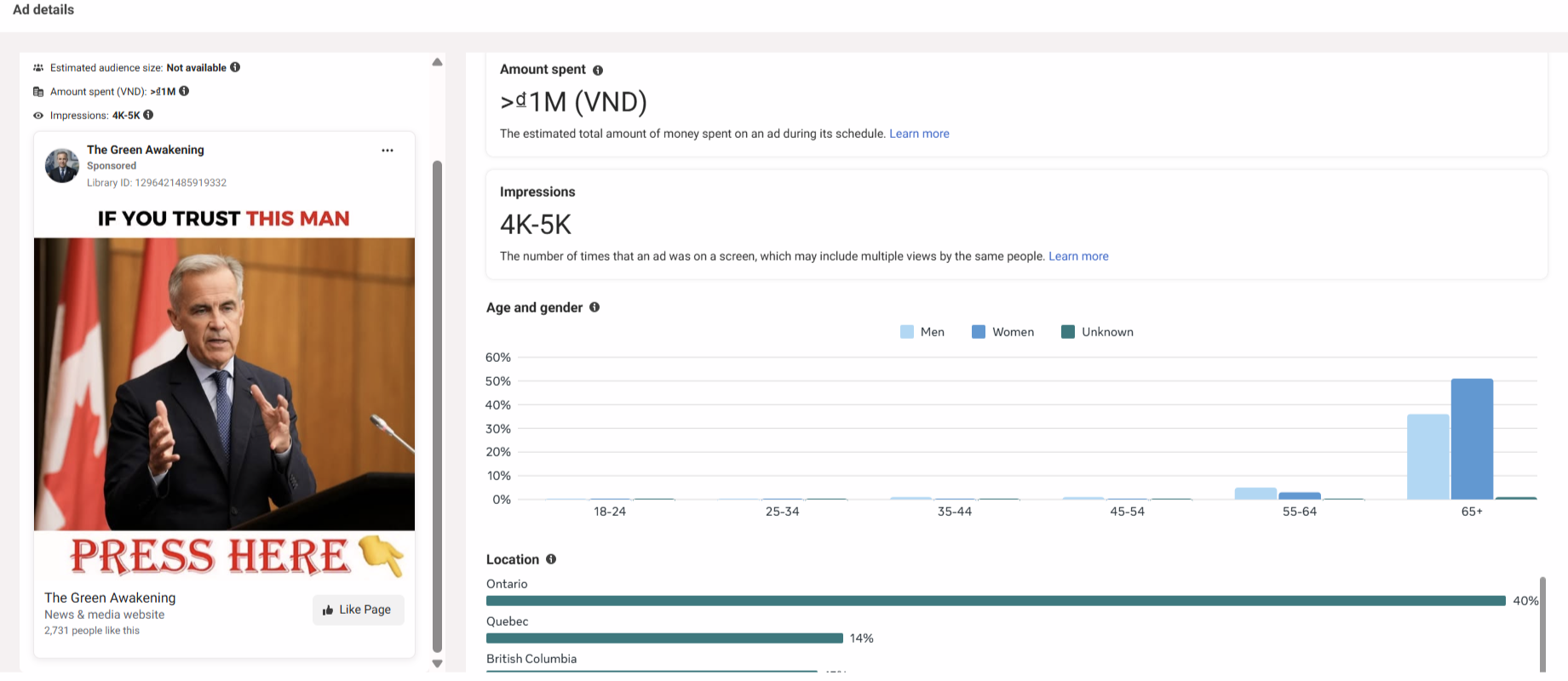
Screenshot from Meta Ad Library showing a Vietnam-operated Facebook page targeting Canadians with AI-generated Ad content.
June 22, 2026 - The Canadian Digital Media Research Network (CDMRN) is releasing Facebook's News Slop Economy, an incident report documenting a commercially motivated network that mass-produces fake stories about politics, celebrities, and sports to drive traffic to fabricated-news websites. Starting from a Canadian investigation, researchers traced a network that has generated more than 95 million reactions, comments, and shares since 2025, and that Canadian advertising dollars are unwittingly helping to bankroll.
This is not a foreign influence operation in the traditional sense. The network doesn't appear to serve a political agenda: the same fabricated stories are recycled interchangeably for politicians from rival parties. What it does serve is profit, but a commercial motive doesn't make the content harmless. When the goal is maximum engagement, inflammatory content travels furthest, and this network has produced a lot of it.
“The network doesn't need a political agenda to cause harm. Flooding the information ecosystem with truth-agnostic stories at this scale undermines public trust and social cohesion, regardless of who’s behind it and what their motivations are.”
Aengus Bridgman, Director, Media Ecosystem Observatory
Key takeaways:
A coordinated network of 340 Facebook pages, largely operated from Vietnam, targets users in Canada, Europe, and the US with AI-fabricated stories about politics, celebrities, and sports to drive traffic to fabricated-news websites and generate ad revenue.
Through Google’s advertising systems and other automated ad exchanges, public-sector organizations and companies, including in Canada, inadvertently fund the network’s business model.
The pages command large audiences (median 11,000 followers): their posts have drawn more than 95 million reactions, comments, and shares since 2025. The network has published 355,296 posts in that period, with a peak of 3,919 posts on a single day (May 4, 2026).
The activity is strongly coordinated: the pages are created and renamed in synchronized batches, and they recycle the same fabricated stories across the network, reusing one template for different public figures, including politicians from opposing parties.
A fact-check of stories in the network’s Canadian-news pages (5,894 posts) found that 54% were false or unsupported, typically pairing a real topic with a fabricated quote, statistic, or fictional dramatized account.
“An automated advertising economy is funneling money from trusted companies and public institutions into a foreign-run network that mass-produces fabricated news. As long as ad exchanges keep cutting cheques and social media platforms keep driving attention to it, content farms will keep producing this slop.”
Mathieu Lavigne, Analytical Lead, Media Ecosystem Observatory
The report calls on social media platforms, advertising systems, and Canadian advertisers to examine how their algorithms, monetization structures, and programmatic campaigns may be inadvertently sustaining this kind of operation.
Media Contact:
Isabelle Corriveau
Associate Director, Public Engagement
media@mediatechdemocracy.com
