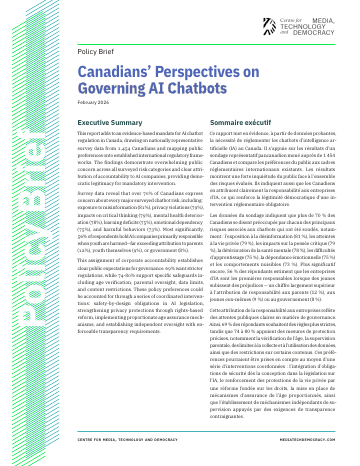
Scoping AI Chatbots into a revised Online Harms Act: The Case for Immediate Action
Taylor Owen, Helen A. Hayes
Executive Summary
This policy brief, addressed to the Minister of Artificial Intelligence and Digital Innovation and the Minister of Canadian Identity and Culture, argues that Canada should immediately scope consumer-facing AI chatbots into a revised Online Harms Act. It opens with two triggering harms: OpenAI's automated systems flagged the Tumbler Ridge shooter's ChatGPT conversations multiple times in June 2025, months before an attack that killed eight people, yet the company banned the account and never contacted police; and the January Grok "undressing" crisis, in which xAI's chatbot was used to generate millions of nonconsensual sexualized images of women and children. In both cases, safety decisions were made unilaterally by American companies with no Canadian regulator empowered to scrutinize them or enforce accountability.
The authors contend that online harms and AI consumer safety should no longer be treated as separate policy files split across the Heritage and AI portfolios. Applying Part 1 of the proposed framework to chatbots would require transparency over safety protocols, mandatory risk assessments, published risk-mitigation plans, age-appropriate design standards, and independent enforcement. They caution against a reporting-first approach that raises Charter and privacy concerns while neglecting upstream design decisions.
The brief notes that Canada is the only G7 country with no digital safety regulator or online harms legislation, contrasting the UK's Online Safety Act, the EU's Digital Services Act, Japan's new obligations, California's Companion Chatbots Act, and Texas's restrictions. It recommends tabling an updated version of Parts 1 and 4 of the Online Harms Act that explicitly scopes in consumer-facing AI chatbots, treated as a priority for the current session.
Related Publications
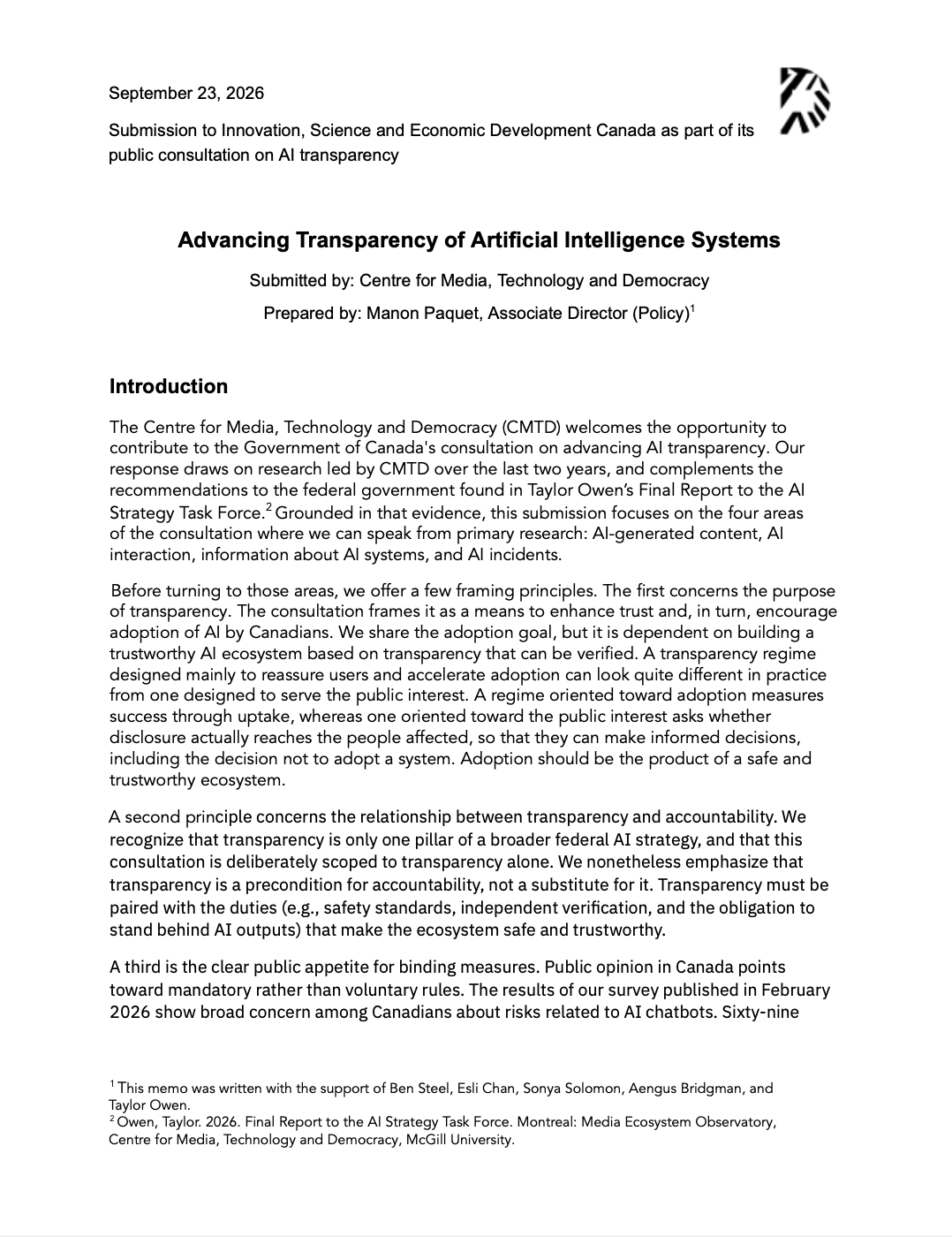
Advancing Transparency of Artificial Intelligence Systems
Read more
Online Harms AI Audit: Policy Memo
Read more
Survey on Canadians' Preference for Social Media Age Verification Policies
Read more