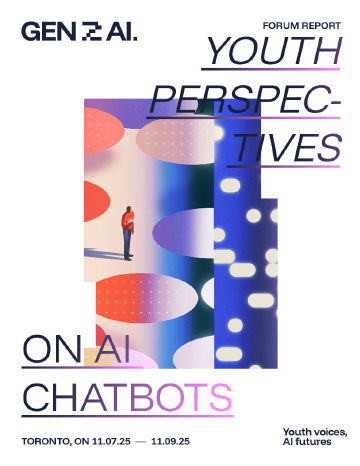
Gen(Z)AI | Forum Report: AI & Age Assurance
Nonso Morah, Helen A. Hayes, Fergus Linley-Mota, Alexander Martin, Madeleine Case, Julian Lam
Executive Summary
This forum report presents findings from the fourth and final Gen(Z)AI forum, held in Halifax and focused on AI and age assurance. Gen(Z)AI is a national youth assembly bringing together 100 young Canadians aged 17-23 to contribute to discussions on AI governance, jointly organized by the Centre for Media, Technology and Democracy and the Dialogue on Technology Project, in partnership with Mila, Quebec's AI Institute, and Make.org. Over three days, participants engaged with expert speakers, took part in workshops, and deliberated on policy challenges related to AI-based age assurance mechanisms, which seek to restrict younger users' access to potentially harmful content, often through AI-based age assessments conducted by third-party verification platforms.
Participants expressed dissatisfaction with existing age assurance technologies, raising concerns about an overreliance on restrictive measures rather than addressing structural deficiencies, limited domestic enforcement standards, and insufficient transparency in how personal verification data is collected, stored, and used. Two core issue statements emerged: that AI-enabled age assurance technologies undermine privacy and digital safety by exposing users to potentially harmful storage and use of their data, and that verification technologies restricting young people's access to social media, AI platforms, and online community spaces risk displacing restricted users to unmoderated and dangerous platforms. Participants also identified generative AI platforms as posing unique risks to children, including increased access to harmful content and negative impacts on cognitive and social development.
In response, participants developed policy recommendations falling into three broad categories: reactive policy mechanisms mandating compliance measures and remedies for harms caused by opaque and unsafe biometric data standards; design and system-level mechanisms that address harm before it emerges through age-appropriate safeguards and adaptive features; and participatory and literacy-building mechanisms leveraging educational awareness and public campaigns. As the concluding forum in the series, these recommendations will be shared with thousands of other young Canadians through Make.org's civic dialogue platform, with participants reconvening in Ottawa on April 30, 2026 to present final recommendations to government officials, policymakers, and civil society organizations.
Key Takeaways
- AI-enabled age assurance technologies undermine privacy and digital safety by exposing users to potentially harmful storage and use of their data.
- Restricted users risk displacement to unmoderated and dangerous platforms when verification technologies limit access.
- Generative AI platforms pose unique risks to children, including increased access to harmful content and negative impacts on development.
Related Publications
Gen(Z)AI: Digital Engagement Companion Report
Read more
Gen(Z)AI: Youth Voices, AI Futures - Policy Recommendations for AI and Online Harms Governance in Canada
Read more
Gen(Z)AI | Forum Report: AI & Data Privacy
Read more