
Deliberative Approaches to Inclusive Governance: An Essay Series
Liz Barry, Claudia Chwalisz, Joseph Gubbels, Lawrence Lessig, Peter MacLeod, Aaron Maniam, Deb Roy, Micah L. Sifry, Alice Siu, Audrey Tang
doi.org/10.66536/deliberative-governance_2025Executive Summary
This seven-essay series, part of the Democratic Legitimacy for AI Initiative, examines how citizen assemblies and civic technology can strengthen the democratic legitimacy of AI governance. It argues that representative democracy and periodic elections alone no longer guarantee governance that is inclusive, responsive, or effective, and that participatory and deliberative processes are needed to embed citizen voice more deeply into decision-making on transformative technologies like AI.
Drawing on case studies from Paris, Canada, Taiwan, Singapore, and the United States, contributors examine how citizens' assemblies and digital deliberation platforms have been used to inform public policy. Claudia Chwalisz examines the Paris Citizens' Assembly, while Peter MacLeod discusses Canada's Citizens' Assemblies on Democratic Expression (CADE), including its recommendations for a Digital Services Regulator, a Digital Ombudsperson's Office, transparency in algorithmic decision-making, and stronger digital literacy and disinformation protections. Micah L. Sifry and Aaron Maniam analyze digital participation initiatives from the Obama administration and Singapore respectively, warning that online platforms can generate engagement without delivering real influence unless properly designed and backed by institutional commitment. Liz Barry and Joseph Gubbels critique AI-driven simulations that substitute algorithmic representations of citizen voice for genuine participation. Deb Roy, Lawrence Lessig, and Audrey Tang explore AI-supported "digital conversation networks" drawing on case studies from Taiwan and the U.S., and Alice Siu examines Stanford's AI-assisted Online Deliberation Platform, used in initiatives such as Foreign Policy by Canadians and the Meta Community Forum, which fostered opinion shifts and increased trust in democratic processes.
The series concludes that digital governance is not inherently democratic and must be paired with institutional safeguards ensuring transparency, inclusivity, and accountability. These insights are intended to inform the Democratic Legitimacy for AI initiative, co-led by McGill University's Centre for Media, Technology and Democracy, Mila, and the Canadian Institute for Advanced Research, which seeks to integrate participatory and deliberative approaches into AI governance in Canada and beyond.
Key Takeaways
- The Paris Citizens Assembly demonstrates that deliberative institutions can move from ad hoc experiments to permanent institutions, producing more durable policy outcomes through collaborative citizen-legislator drafting.
- Canada's Citizens Assemblies on Democratic Expression (CADE) showed that well-designed deliberative processes build civic trust across partisan lines and produce cross-partisan consensus on contentious digital policy questions.
- Tech-enabled e-democracy often fails when it prioritizes scale over genuine deliberation, with lessons from Barack Obama's presidency showing how digital engagement can become symbolic.
- Four archetypes of government-citizen interaction exist (informing, consulting, involving, co-creating); most civic tech remains stuck in lower-accountability modes.
- AI tools like Polis can map genuine cross-partisan consensus in large-scale deliberative processes, demonstrating AI can enhance rather than undermine democratic deliberation when designed around democratic values.
Related Publications
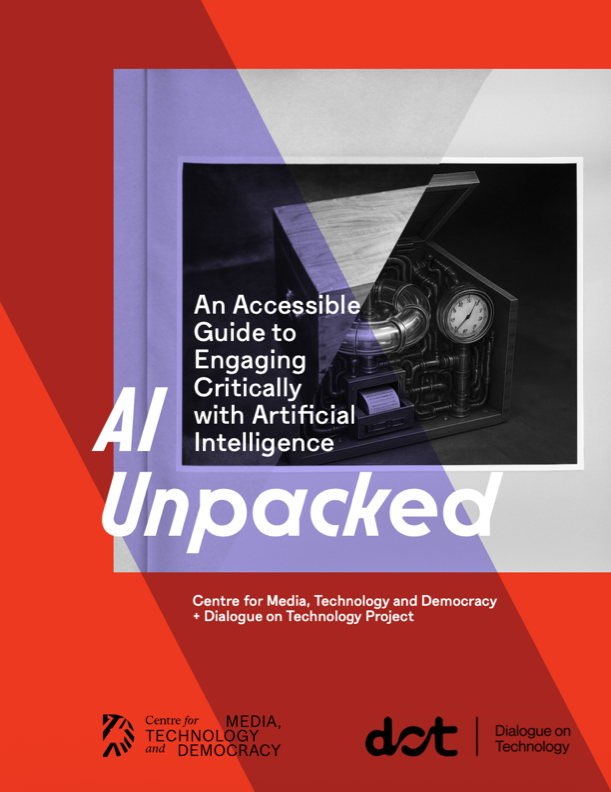
AI Unpacked: An Accessible Guide to Engaging Critically with Artificial Intelligence
Read more
Gen(Z)AI: Youth Voices, AI Futures - Policy Recommendations for AI and Online Harms Governance in Canada
Read more
Gen(Z)AI | Forum Report: AI & Age Assurance
Read more